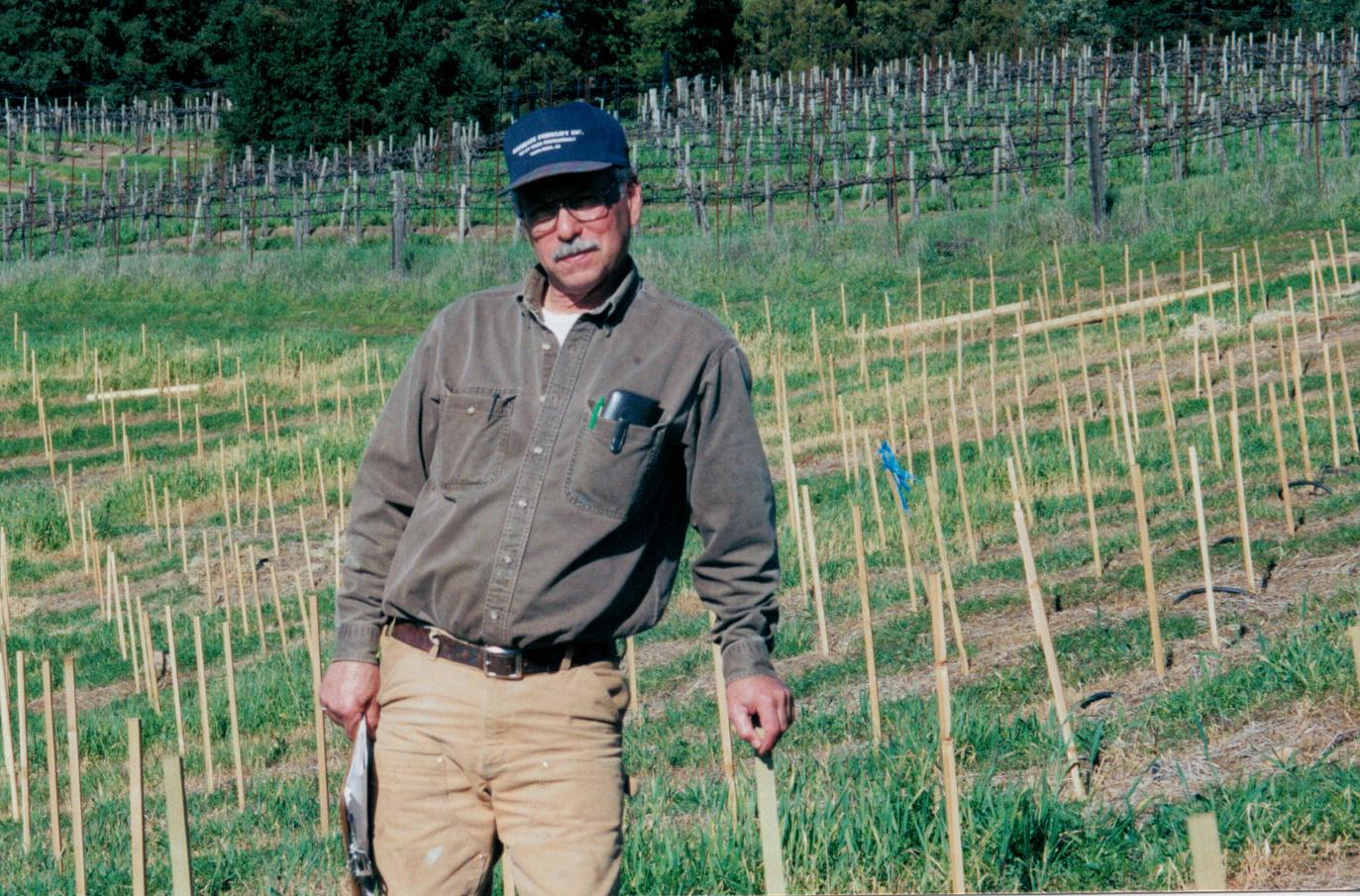
Founder David Hirsch passed away on July 28, 2026. He was 81.
Eric Asimov wrote a beautiful obituary about David for the New York Times, and can be read here (paywall). David’s incredible life story can be found below.
About David
David Hirsch bought the land that would become Hirsch Vineyards in 1978. It was a 1,000 acre sheep ranch, 2.5 hours from the Golden Gate Bridge, near Fort Ross. It’s mysterious that a kid who grew up in the Bronx, with no connection to farming or ranching, would be drawn to this wild, rugged and remote place.
David bought the land not to plant vineyards, but rather so he could hear himself think, as he put it. The land was cheap, as this was not a viticultural region yet. It had been logged and grazed, and the land needed ecological restoration. He looked around for what the land was suited and that could produce income to care for it. With the advice of his friend Jim Beauregard, he planted one acre of own-rooted Pinot Noir and two acres of Riesling, in the middle of the ranch on a site overlooking the Pacific Ocean.
David fell in love with wine first in the Santa Cruz Mountains, where he settled in the 60s after dropping out of Columbia. His first career, in the garment industry, frequently took him to Paris in the 70s. He would take the train down to Beaune and visit the wineries of Burgundy, falling in love with Pinot Noir, but also with a lifestyle that interconnected food, wine and farming. He was a self-taught wine lover and gourmand, and his enjoyment of food and wine had an authenticity and intensity that was contagious.
In the late 80s he left the garment business to dedicate himself fulltime to farming. He planted 44 acres between 1990 and 1997, and another 27 between 2002 and 2003. His respect for this site was such that he used to say, “developing the 27 acres in the 2000s was my thesis to graduate from kindergarten”.
In 1994 David began selling fruit to Kistler, Williams Selyem and Littorai, bringing greater attention to his vineyard and region. 2026 will be the 33rd vintage that Williams Selyem and Littorai will purchase Hirsch grapes. Steve Kistler remained a friend and drinking buddy of David’s until the end.
In 2002 David built a winery on his ranch “in order to become a better farmer”. He had divided his vineyard into more than 60 individual parcels, driven by the dramatic and sudden changes in soil and aspect created by San Andreas Fault, which lies less than a mile from Hirsch. As he farmed each parcel individually, so he wanted to taste each of them individually. He called his terroir “earthquake terroir”.
Farming out here in the coastal redwood rainforest is not for the faint of heart. Building and operating a winery here is perhaps even more fraught. Dirt roads, no public water or septic, limited power, hardly any people. In order to have sufficient power for the winery, David built a 10 mile long power line to connect to PG&E – he called it his 10 mile long extension cord. Carving a vineyard, home and winery out of this place required a person of great vision, determination and fearlessness. David was all of those things. And he also loved to work.
He centered everything at Hirsch around the vineyard and the land. The winery is here to serve the vineyard, to help us become better farmers. The wines are here to provide a lens into the vineyard, not to express our egos or stylistic preferences. He said his title was “Chief Bug”, because he was responsible for reminding all of us ad nauseam that our goal is always to focus on the site.
In 2011 he began the process of converting his vineyards, orchards and gardens to biodynamic practices. He said it was a return to his original intention from 1980, to heal the land ecologically. The biodynamics were an extension of his personal spiritualty and sense of responsibility towards this land.
Beyond viticulture, David was a devout Zen Buddhist, active in his religious community until the end. He loved fashion and was known for his Borsalino hats. He was studious and a great collector of books. He loved to travel. He loved Venice, Rome, New York, Japan. He told incredible stories about his early years in textiles, trading in Oaxaca, working in Asia, travelling through Europe.
In 2014, he was in a tractor accident while building compost piles. The accident left him paralyzed and critically injured. It was a long and difficult road to recovery, but he survived, and despite his paralysis, he made a new and good life for himself. He returned to his work managing the vineyards and biodynamics, bought an ATV with hand controls so he could get back into the fields, and he planted five new acres of vineyards, which will give us fruit for the first time next year.
David is survived by his wife Marie, and his children Jessica, Jasmine and Joseph, and his siblings Adam, Betty, Susan and Daniel.